
Habit Stacking for Wellness: Making Infrared Fitness Part of Your Routine
Habit stacking means attaching a new habit to one you already have on autopilot. Instead of relying on motivation to remember a new wellness routine, you tie it to something you already do without thinking, like your morning coffee or your drive home from work. For wellness technology like infrared fitness, recovery pods, or red light sessions, this small shift is often the difference between a routine that sticks and one that quietly disappears after two weeks.
And if that sounds familiar, you are in good company. If you have ever bought a gym membership, a gadget, or booked a few wellness sessions with the best intentions and then let them fade, please know that is not a willpower problem. It is a design problem, and a genuinely simple one to fix. That is exactly what habit stacking is for.
What Is Habit Stacking, Exactly?
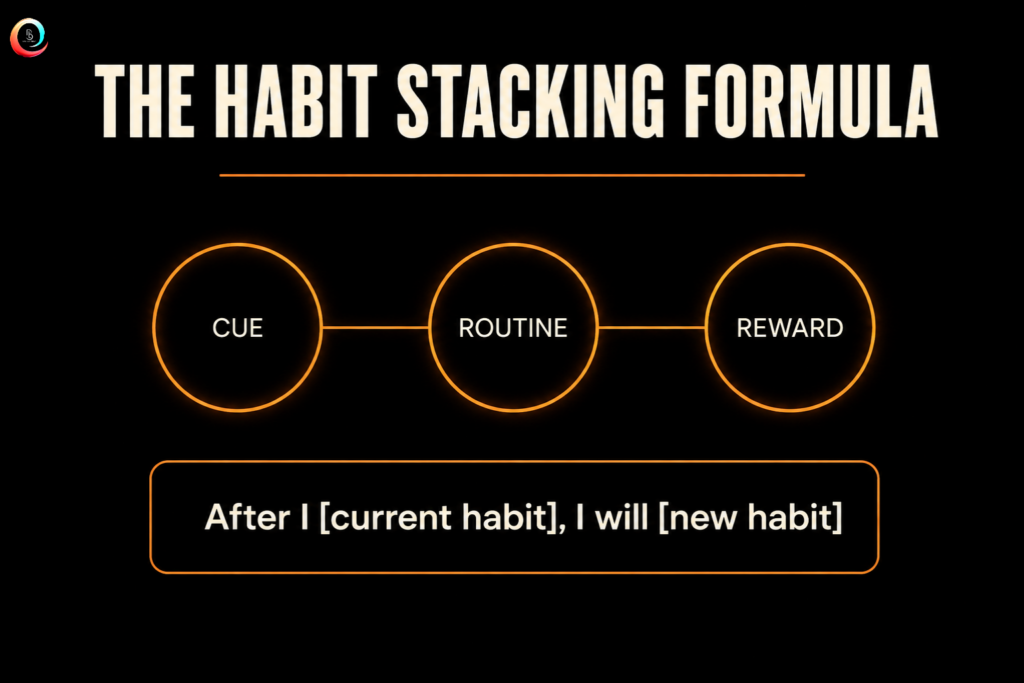
Habit stacking is a behavior change method built on a simple formula: after I [current habit], I will [new habit]. Instead of asking your brain to remember a brand new routine out of nowhere, you borrow the momentum of a habit that already runs on autopilot.
The idea builds on something psychologists have studied for decades, the cue, routine, reward loop. A cue triggers the behavior, the behavior becomes the routine, and a reward reinforces it enough that your brain starts running it automatically. The American Psychological Association uses this exact framework to teach how habits form in the first place, and it is the same loop habit stacking is designed to borrow from.
Instead of creating a brand new cue from scratch, habit stacking uses an existing one you already respond to every day, your morning shower, your commute, your lunch break, and attaches the new behavior right to it. Simple, and honestly kind of a relief once you see it laid out this way.
Why Pairing Habits Actually Works
This is not just a productivity trend. It has real, reassuring support behind it.
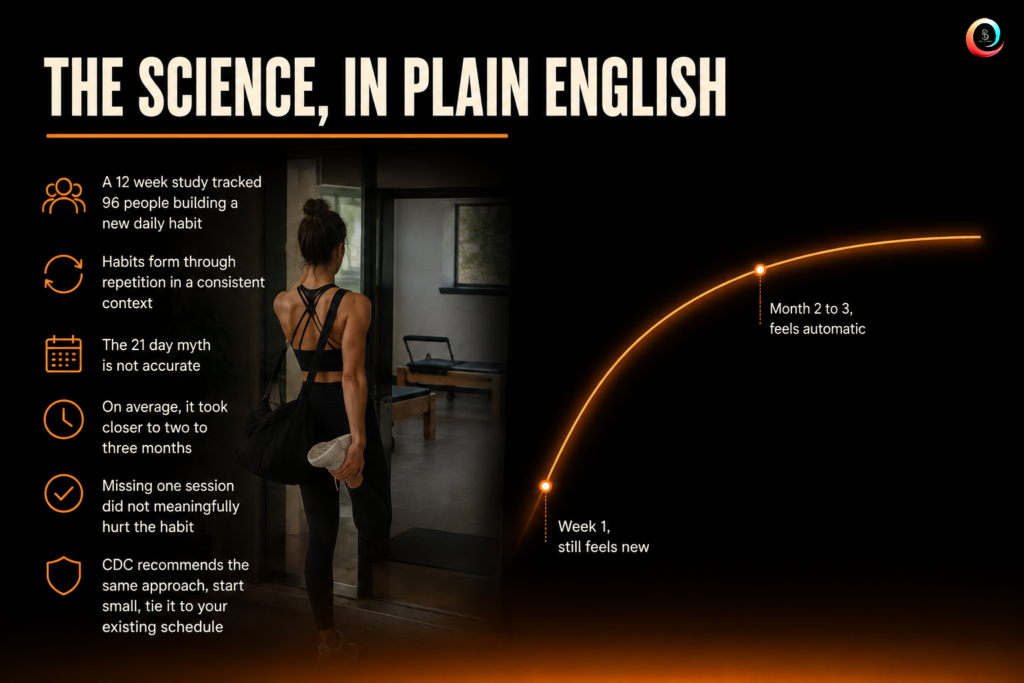
A widely cited study published in the European Journal of Social Psychology tracked 96 people trying to build a new daily habit over 12 weeks. Here is what they found:
- Habits form through repetition in a consistent context, not through willpower alone
- The behaviors that stuck the best were tied to a stable daily cue, like doing something right after a specific meal or routine already in place
- The popular idea that habits form in 21 days is not accurate
- On average, it took closer to two to three months, and for some behaviors, considerably longer
- Relying on short bursts of motivation rarely works long term, consistency does
So if a habit hasn’t stuck yet, that likely just means you haven’t given it enough time, not that you did something wrong.
The takeaway for wellness technology is simple and honestly pretty encouraging. A new infrared fitness session or recovery routine is far more likely to survive its first month if it rides on a cue you already respond to automatically, rather than existing as a floating item on your to do list.
The Centers for Disease Control and Prevention recommends a similar approach for building any new health habit:
- Start small
- Tie new activity to your existing schedule
- Build confidence with something manageable before adding more
That is habit stacking in practice, even when it is not called that by name.
Ready to build your own stack?
Our team genuinely enjoys helping people map a session onto a routine they already have. No guesswork, no pressure, just a friendly starting point.
Book You First VisitHow To Habit Stack With Wellness Technology
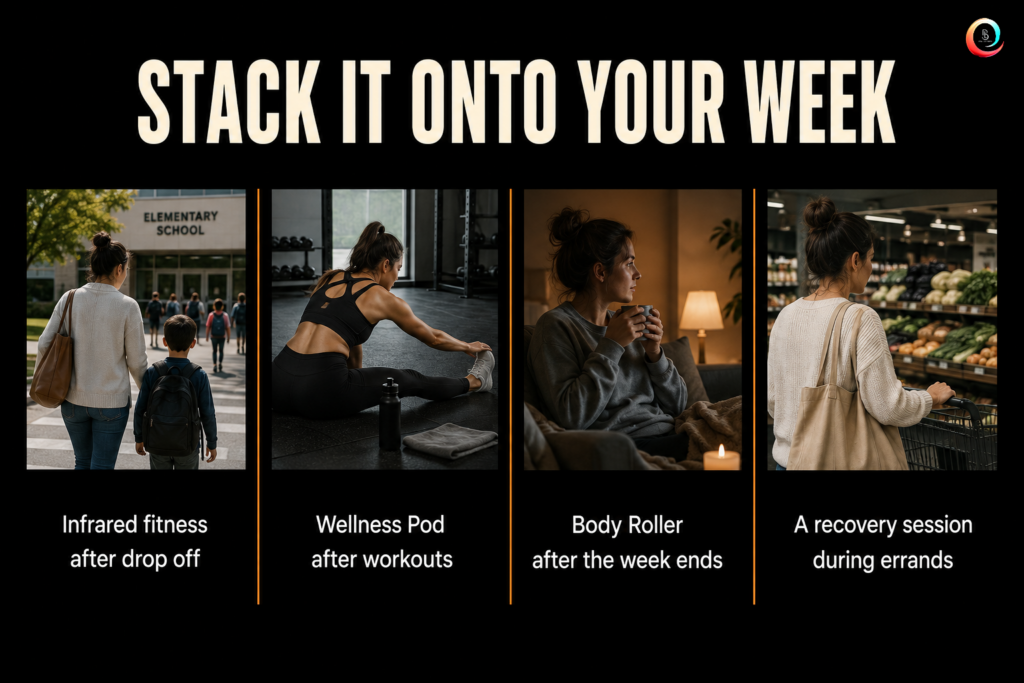
The formula stays the same no matter what session you are trying to build into your week.
After [existing habit], I will [wellness session].
A few ways this plays out in real life:
- After I drop my kids at school, I will stop in for a 20 minute infrared fitness session
- After my Tuesday and Thursday workouts, I will spend 15 minutes in a Wellness Pod to support recovery
- After my Friday work week ends, I will book a Body Roller session to unwind before the weekend
- After my usual Sunday errands, I will use that same window for a recovery focused session instead of scrolling on the couch
Notice none of these depend on finding new time. They gently borrow time and momentum that already exists in your week, which is honestly the kindest way to build a new habit.
Start With the Anchor, Not the Goal
Most people build their routine backwards, and it is so common that there is nothing to feel bad about here. They start with the goal, “I want to feel more recovered,” and then try to force a new time slot into an already full week. Habit stacking flips that around. You start by identifying a habit you already do reliably, and then ask what wellness session fits naturally on the other side of it.
If you already stop for coffee every morning on your way to work, the studio on that same route becomes a much easier stack than a session across town at a time you have never used before.
Track the Stack, Not Just the Goal
Once you have a stack in place, the most useful thing to track is whether you followed through on the pairing, not just whether you hit a bigger outcome goal. “Did I do my session after my usual Tuesday workout” is a habit level question, while “did I lose ten pounds” is an outcome level question that depends on far more than consistency alone. Habit level tracking builds the behavior first, and the outcomes tend to follow naturally once the behavior is actually happening every week instead of every once in a while.
Not sure which session fits your routine best?
We would love to help. A quick, no pressure chat with our team can help match the right session to a habit you already have.
Book a Free ConsultationHabit Stacking Ideas for Body Lab Sessions
Here is how this framework maps onto what we actually offer in studio, so you can picture it a little more clearly.
|
If your existing habit is… |
Consider stacking… |
|
A weekday morning routine |
A short infrared fitness session before the day gets busy |
|
Your regular workout days |
Time in an infrared pod afterward to support recovery |
|
Your Friday wind down |
A Body Roller session to close out the week |
|
A weekly errand run near the studio |
A drop in session on the same trip, no extra driving required |
If you are newer to infrared and want the full picture of how it works before building it into your week, our friendly guide on what infrared actually is is a warm place to start.
Common Mistakes When Habit Stacking
No judgment here, these are just the patterns we see most often, gently flagged so you can sidestep them.
- Stacking onto an unstable habit. If the habit you are stacking onto is not consistent yet, the new one will not be either. Pick something you already do every single day or every single week without fail.
- Stacking too many things at once. Trying to attach three new wellness habits onto one existing routine overwhelms the cue instead of using it. Add one at a time, and be proud of that one.
- Skipping the plan for hard days. Life will interrupt your routine at some point, and that is okay. The Lally et al. research on habit formation found that missing a single opportunity did not meaningfully hurt long term habit strength, so one missed session is not a failure, it is just a normal Tuesday. The habit that survives is the one you return to, not the one you never break.
- Choosing convenience over consistency. The best session is the one on your actual path, not the “ideal” one across town that requires a special trip. Be kind to your future self and pick the easy one.
Try It At Body Lab
The easiest way to find out which stack works for you is to feel it for yourself. Our team would genuinely love to help you find the session that fits naturally into a routine you already have, no overhaul required, just a warm nudge in the right direction.
Let's find your starting point together.
Tell us about your week and we will help you find a session that fits right in, no changes to your schedule required.
Book Your First VisitFrequently Asked Questions
How long does it actually take to build a new wellness habit?
Research suggests it takes closer to two to three months on average, not the popular 21 day myth, and the timeline varies quite a bit from person to person and behavior to behavior. Give yourself grace here.
What if I miss a session, does that ruin the habit?
Not at all. Research on real world habit formation found that missing a single opportunity did not meaningfully disrupt the process. Consistency over time matters so much more than perfection.
Do I need to change my schedule to fit this in?
Not usually, and that is kind of the whole point. Habit stacking attaches a new session to time you already have, rather than asking you to find new time from scratch.
Can I stack more than one wellness habit at once?
You can, but it is easier to succeed by adding one at a time and letting it become automatic before stacking another on top. One steady win beats three shaky ones.
What is the easiest habit to stack a wellness session onto?
Something you already do daily without fail works best, a commute, a meal, a school drop off, or an existing workout.
- Lally, P., van Jaarsveld, C. H. M., Potts, H. W. W., & Wardle, J. (2010). How are habits formed: Modelling habit formation in the real world. European Journal of Social Psychology, 40(6), 998–1009. Wiley Online Library. https://onlinelibrary.wiley.com/doi/abs/10.1002/ejsp.674
- Centers for Disease Control and Prevention. Fitting a New Habit Into Your Life. https://www.cdc.gov/diabetes/prevention-type-2/new-healthy-habits.html
- American Psychological Association. TOPSS Activity 7.2, Habit Formation. https://www.apa.org/ed/precollege/topss/lessons/activities/activity-habit-formation.pdf